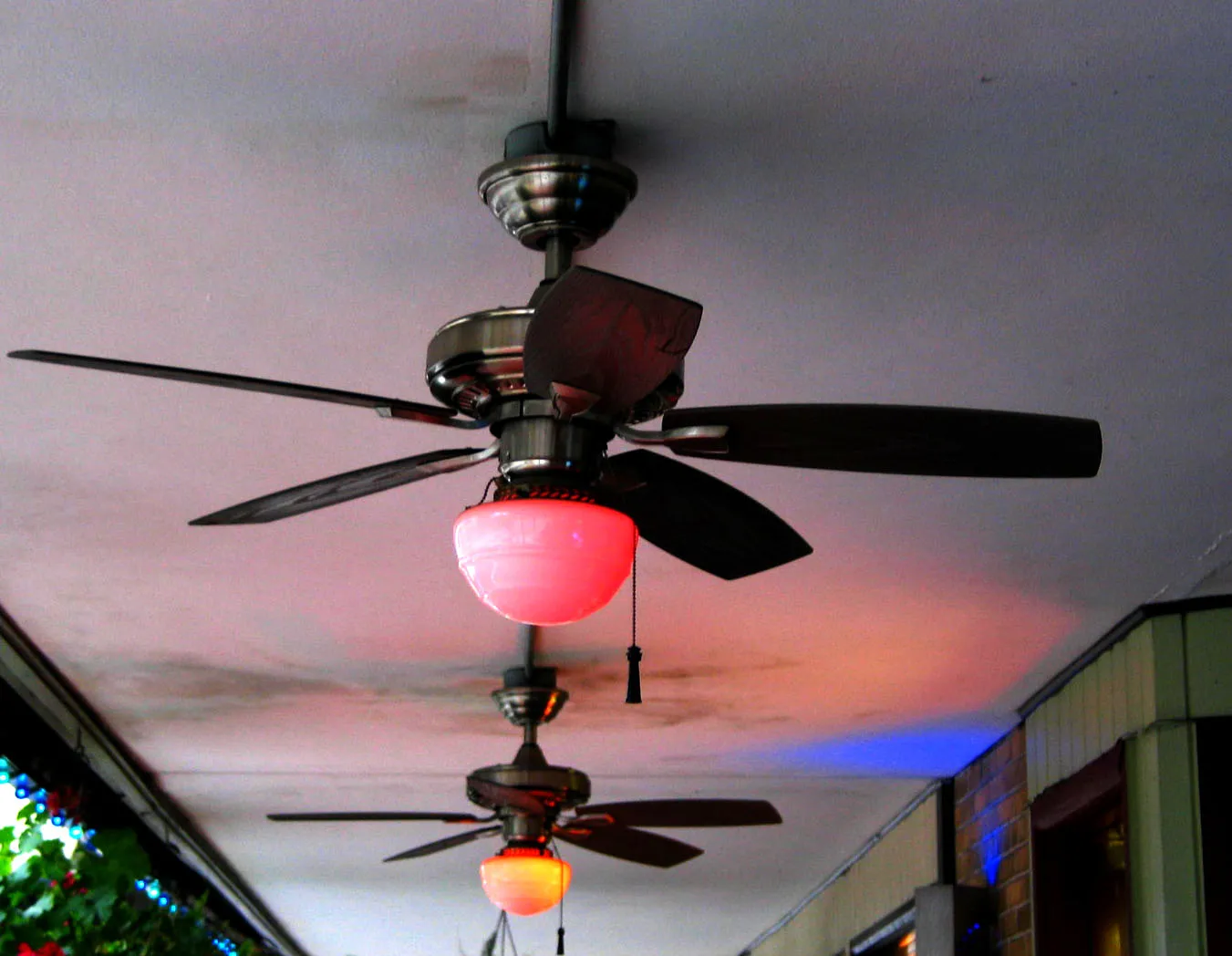

Quick answer: For a Georgia home, pick an ENERGY STAR certified fan sized to the room, with a DC motor if you can, and run it counterclockwise from late spring through fall. A fan lets you nudge the thermostat up about 4°F without feeling warmer [5], and certified fans are up to 44% more efficient than conventional ones [3]. The four below are all on the EPA’s certified list [4].
At a glance
- When the heat starts
- Atlanta's average first 90°F day is May 31 [2]
- Hotter outside Atlanta
- Macon, Columbus and much of the coast typically top 90°F in summer, often 95°F [1]
- Thermostat gain
- About 4°F higher with a ceiling fan, no loss in comfort [5]
- ENERGY STAR advantage
- Up to 44% more efficient than conventional fans [3]
- Fans have limits
- In very hot weather, a fan won't prevent heat illness [6]
Why fans matter here
Georgia’s summers are long and humid. In Atlanta, average summer highs sit in the high 80s, while lower inland cities like Macon and Columbus, and many coastal towns, typically reach above 90°F and often above 95°F [1]. The National Weather Service office in Peachtree City puts Atlanta’s average first 90-degree day at May 31 [2], which means most homes run air conditioning for four or five months. A ceiling fan doesn’t cool the air; it moves it across your skin. That lets you set the thermostat higher and run the AC less [5].
How we chose
- ENERGY STAR certified, checked by model number in the EPA’s certification data [4]. We compared efficiency in cubic feet of air per minute per watt (CFM/W): higher means more air for the same electricity.
- Specs from the maker: size, motor, speeds and controls come from each maker’s product page.
- Recall check: we searched the CPSC recall database for each brand and model on November 2, 2026, and left out anything recalled.
- A spread of rooms: picks for a small bedroom, a typical bedroom or den, a quiet room with smart controls, and a large living room.
Our picks
Best for: Small bedrooms and home offices
Hunter 44-inch Swanson (ENERGY STAR)
A small fan with a DC motor that the EPA rates at about 257 to 259 CFM/W, depending on finish, so it moves a lot of air for very little power. Hunter sizes it for rooms up to 100 square feet.
- 44-inch span, 5 reversible blades [7]
- DC motor; 3,309 CFM on high per Hunter [7]
- 1.6 to 1.7 W on low, 16.4 to 17.8 W on high, by finish (ENERGY STAR data) [4]
- Pull-chain control; LED bowl light with 2 bulbs [7]
Safety check: ETL listed per Hunter; ENERGY STAR certified. No CPSC recall found for the Swanson (checked 2026-11-02).
Watch out: Pull chains only, no remote, and the light isn't dimmable. Too small for a living room.
See it on Amazon → We chose it from specs and safety records; we haven't tested it ourselves.
Best for: Typical bedrooms and dens
Hunter 52-inch Fonthill (ENERGY STAR)
The most efficient fan in this group in the EPA data, at 353.4 CFM/W, and it meets ENERGY STAR's Most Efficient criteria. It has a 6-speed reversible DC motor and a handheld remote that also reverses direction for winter.
- 52-inch span, 6 blades [8]
- 6-speed reversible DC motor with remote [8]
- 2.5 W on low, 17.7 W on high (ENERGY STAR data, models 52901/52903/52904) [4]
- Integrated dimmable LED light [8]
Safety check: ETL/UL tested per Hunter; ENERGY STAR Most Efficient. No CPSC recall found for the Fonthill (checked 2026-11-02).
Watch out: Needs a downrod mount, so it isn't the best choice for ceilings under 8 feet. Hunter's own store listed it as sold out when we checked.
See it on Amazon → We chose it from specs and safety records; we haven't tested it ourselves.
Best for: Quiet bedrooms and smart-home control
Big Ass Fans Haiku L, 52-inch
ENERGY STAR rates the 52-inch size at 269 CFM/W. It uses a permanent-magnet motor that Big Ass Fans describes as whisper-quiet, and it works with a remote, the app and voice assistants.
- 52-inch span; also sold in 44 and 60 inches [9]
- Permanent-magnet motor [9]
- 33.5 W on high (ENERGY STAR data, model FR127C-U1H) [4]
- Remote and app control; Wi-Fi module optional [9]
- Included 5-inch downrod suits 8 to 9 foot ceilings [9]
- 5-year indoor warranty [9]
Safety check: ENERGY STAR certified. No CPSC recall found for Big Ass Fans or the Haiku line (checked 2026-11-02).
Watch out: Costs several times more than the Hunter fans here, and smart-home control needs the separate Wi-Fi module.
See it on Amazon → We chose it from specs and safety records; we haven't tested it ourselves.
Best for: Large living rooms and open floor plans
Hunter 60-inch Aerodyne Smart Fan (ENERGY STAR)
A 60-inch fan for big rooms that still meets ENERGY STAR's Most Efficient criteria, at 302.8 CFM/W. It connects to Wi-Fi, so you can set schedules or turn it off from your phone when you leave the room.
- 60-inch span [10]
- 6-speed DC motor with handheld remote [10]
- 1.3 W on low, 32.6 W on high (ENERGY STAR data, models 52832/52833) [4]
- Works with Apple Home, Google Home and Amazon Alexa [10]
Safety check: ENERGY STAR Most Efficient. No CPSC recall found for the Aerodyne (checked 2026-11-02).
Watch out: Smart features depend on your home Wi-Fi. Hunter recommends a downrod for ceilings 9 feet and higher, and a 60-inch fan crowds a small room.
See it on Amazon → We chose it from specs and safety records; we haven't tested it ourselves.
Buying guide
- Match the size to the room. Small rooms (up to about 100 square feet) suit a fan in the low 40-inch range; bedrooms and dens, about 52 inches; large rooms, 60 inches or more. Makers list a recommended room size on each product page.
- Compare CFM/W, not just CFM. Airflow alone tells you how much air a fan moves; CFM/W tells you how much it costs to move it. The EPA list shows both [4].
- Check your ceiling height. Low ceilings need a low-mount fan. Taller ceilings need a downrod so the blades sit in the room, not against the ceiling.
- Use it right. Run it counterclockwise in summer and turn it off when you leave the room [5]. A fan cools people, not rooms.
- Porches need an outdoor rating. For a covered porch, buy a fan the maker rates for damp or wet locations. The four above are indoor fans.
Sources
- NOAA NCEI and NC State: Georgia State Climate Summary 2022
- National Weather Service, Atlanta/Peachtree City: Average, first and last dates of 90, 95 and 100 degrees
- ENERGY STAR: Ceiling Fans
- ENERGY STAR Certified Ceiling Fans (EPA data set, checked 2026-11-02)
- U.S. Department of Energy: Energy Saver Guide (2022)
- CDC: Heat and People Without Air Conditioning
- Hunter Fan: Swanson ENERGY STAR with LED Bowl, 44 inch
- Hunter Fan: Fonthill Indoor HunterExpress with LED Light, 52 inch
- Big Ass Fans: Haiku L Ceiling Fan
- Hunter Fan: Aerodyne Indoor Smart Fan ENERGY STAR, 60 inch
Common questions
How much can a ceiling fan save on cooling in Georgia?
The Department of Energy says a ceiling fan lets you set the thermostat about 4°F higher with no loss in comfort. The savings come from running the air conditioner less, so turn the fan off when you leave the room; it cools people, not rooms.
Which way should a ceiling fan spin in summer?
Counterclockwise, looking up at it. That pushes air down and creates a wind chill effect. In winter, reverse it to clockwise at low speed.
Is an ENERGY STAR ceiling fan worth it?
ENERGY STAR says certified fans are up to 44% more efficient than conventional fans. Every fan on this page is in the EPA's certified list, and you can compare models by airflow per watt (CFM/W) in that list.